Traffic Management Plan (TMP) in Malaysia — Complete 2026 Guide
Everything a Malaysian contractor, project manager or developer needs to know about preparing, submitting and getting approval for a Traffic Management Plan — JKR, REAM, ATJ 2C/85 standards, approval timelines, common rejection reasons, and a downloadable checklist.
A TMP — short for Traffic Management Plan — is the regulatory document a Malaysian contractor must prepare and submit before any work that affects a public road can begin. A TMP describes how the project will move vehicles and pedestrians safely through or around the work zone for the entire project duration. Approval authority depends on road type: JKR for federal/state roads, highway concessionaires (PLUS, LPT2, Litrak, Prolintas, KESAS, SPRINT) for tolled highways, local councils/DBKL for city roads. Governing standards: ATJ 2C/85 (the foundational Malaysian arahan teknikal jalan) and JKR signage specifications. Key rejection reasons: missing traffic count data, inadequate sign-spacing geometry, no Emergency Response Team (ERT) plan.
The full term "Traffic Management Plan" and the abbreviation "TMP" are used interchangeably throughout Malaysian industry — JKR letters, highway concessionaire submissions and project documentation all use both forms. This guide uses "TMP" for the document itself and "TMP design", "TMP submission" and "TMP approval" for the three workflow stages every Malaysian project goes through.
This guide is written by Muhibah Konsortium Holdings — a G7 CIDB-registered traffic management contractor based in Bandar Baru Bangi, Selangor. We have designed, supported and run hundreds of TMPs across federal roads, MRT/LRT works, MRT Corp guideway projects, and highway concessionaire works since 2009.
What you'll learn in this guide
- When a TMP is legally required (and when a simpler "method statement" suffices)
- The three approval pathways and which authority applies to your project
- What 14 sections must appear in a JKR-acceptable TMP
- Approval timelines by road type — and how to compress them
- Common rejection reasons (and how to avoid them on first submission)
- Cost ranges for TMP preparation, equipment supply and team deployment
- Difference between TMP, Pelan Pengurusan Trafik, ATJ 2C/85 deployment plan and Emergency Response Plan (ERP)
- Who is qualified to prepare and sign off a TMP (CTMO, TMO, registered engineer)
TMP — what the abbreviation means in Malaysian road works
TMP stands for Traffic Management Plan. In Malaysian construction and road-works practice, "TMP" is the standard short-form used in tender documents, JKR cover letters, highway concessionaire submissions and authority approval letters. Whenever an authority refers to a "TMP", a "submitted TMP", an "approved TMP" or an "active TMP", they are referring to the same regulatory document — the Traffic Management Plan that governs how the work zone will be set up, signed, manned and removed.
Closely related abbreviations a Malaysian site team encounters every week: TMP design (the layout drawing and accompanying narrative), TMP submission (the package sent to JKR or the highway concessionaire for approval), TMP approval (the letter back from the authority), TMP revision (when scope or staging changes mid-project) and TMP daily log (the on-site compliance record kept by the Construction Traffic Management Officer). All five stages reference the same TMP document — only the workflow phase differs.
When is a TMP required in Malaysia?
A TMP is required for any work that affects a public road — including but not limited to:
- Road construction, widening, resurfacing — federal roads, state roads, expressways
- Utility works — TNB cable laying, IWK pipe works, fibre optic deployment
- MRT/LRT guideway construction — MRT Corp standard requires full TMP for guideway sections crossing or affecting roads
- Major commercial development with site access from a public road during construction
- Telecommunications tower installation requiring crane setup on a road shoulder
- Event traffic management — large-scale public events affecting normal traffic flow
For minor private-land works that do not affect a public road, a TMP is generally not required, but a basic method statement covering site safety should still be prepared as part of the contractor's OSH compliance.
Send us the location and a one-line scope on WhatsApp. We will tell you which authority applies — JKR, a highway concessionaire or the local council — and what they will ask for. Or see our TMP design & Traffic Management Officer service.
Ask us on WhatsAppWho approves a TMP? Three pathways explained
Approval authority depends on the road type. There are three main pathways:
Pathway 1: Federal/state roads (JKR)
JKR Negeri (state-level Public Works Department) is the lead approval body for any work on federal or state-classified roads. Submission flow: contractor → JKR Negeri TMP officer → revisions → approval letter. Submission and follow-up are handled by the contractor; Muhibah supplies the design package and supports any revision rounds the authority requests.
Pathway 2: Tolled highways (concessionaire)
Highway concessionaires (PLUS, LPT2, Litrak, Prolintas, KESAS, SPRINT, Touch 'n Go-managed sections, etc.) have their own TMP review departments with stricter standards than general JKR roads. Approval flow: contractor → concessionaire engineering office → revisions → concessionaire approval letter. Specific concessionaires (PLUS in particular) require LLM-grade signage (Lembaga Lebuh Raya Malaysia) which is a higher reflectivity class than JKR-grade.
Pathway 3: City roads (council/DBKL)
For roads under DBKL (Kuala Lumpur), MBPJ (Petaling Jaya), MBSJ (Subang Jaya), MBSA (Shah Alam) and other Pihak Berkuasa Tempatan (PBT/local councils), the city engineering department reviews the TMP. Often coordinated with the council's public-events officer if the work spans a weekend or affects a major junction. The contractor handles the submission and any follow-up with the authority.
Multi-authority projects (e.g., a bypass road that crosses both federal and city jurisdictions) require parallel submissions. Plan an extra 2 weeks for cross-coordination.
What does a TMP design actually look like?
The layout drawing is the heart of a TMP — it shows exactly where every sign, cone and barrier goes, and how traffic is moved through or around the work zone. Per ATJ 2C/85, every TMP design has four functional zones, in order along the direction of travel:
A typical highway TMP layout drawing shows all four zones to scale, with every sign labelled by its JKR/REAM type code, every cone spacing dimensioned, and every barrier section identified by length. For a single-lane closure on an 80 km/h road, the full TMP layout can stretch 500-800 metres from first warning sign to termination sign — much longer than most non-specialists expect.
Real examples from Muhibah projects
Three sanitized TMP layouts from projects we have delivered. Client title blocks have been blurred for confidentiality; the layout, signage geometry and zone structure are exactly as approved.
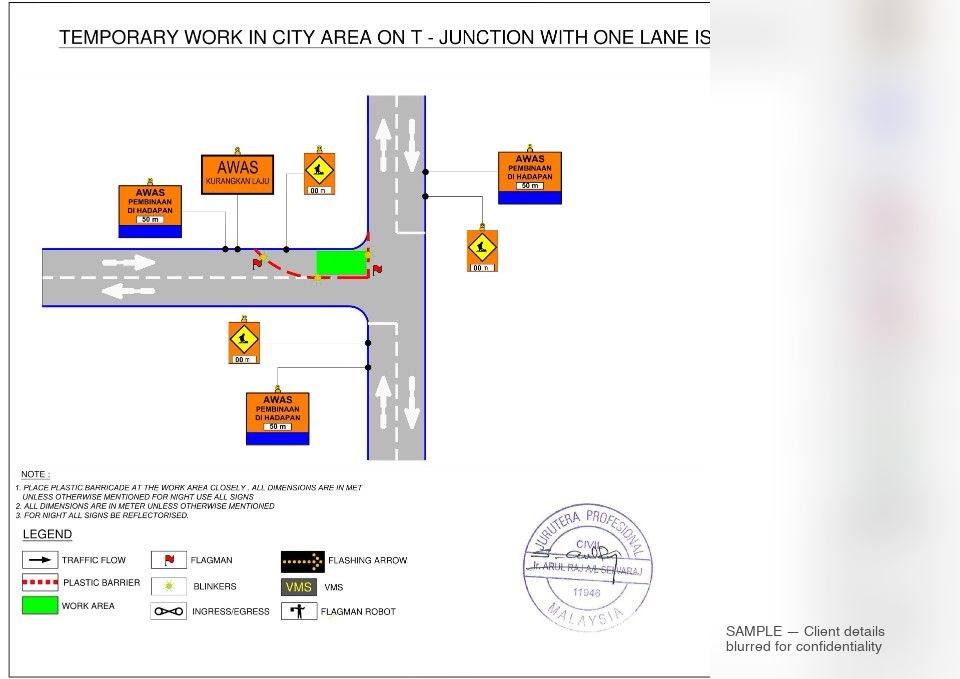
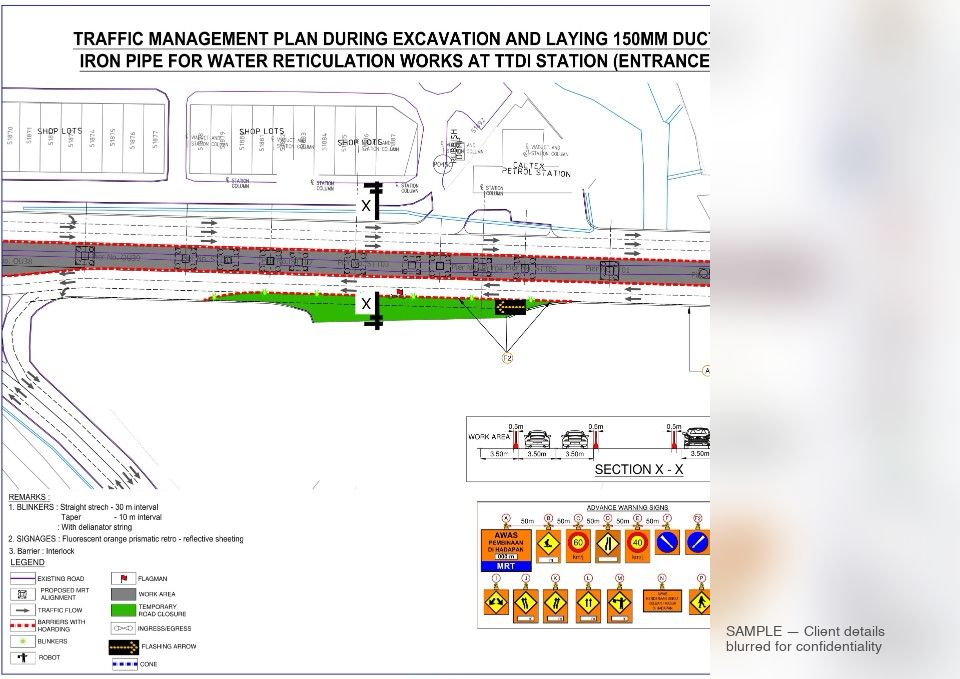
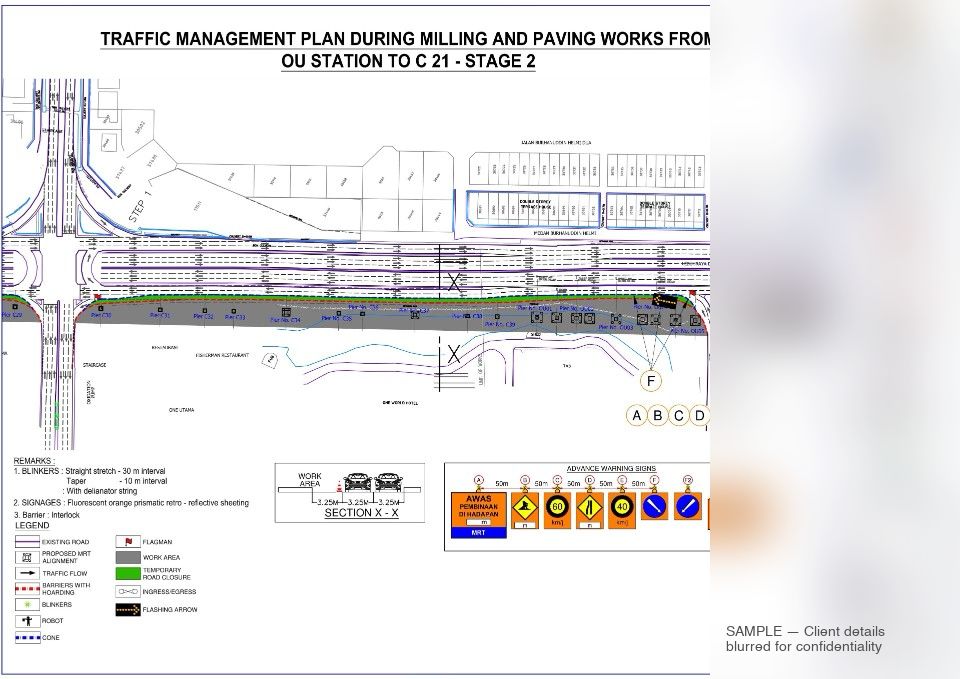
We have hundreds of approved TMP designs across federal roads, MRT/LRT works, urban utilities and PLUS/LPT2/Litrak highway projects. WhatsApp us with your project type and we'll prepare a draft layout — typical turnaround 5-7 working days from confirmed scope.
Request a TMP design quoteWhat goes in a JKR-acceptable TMP — the 14 required sections
A complete TMP submission to JKR or a highway concessionaire typically contains these 14 sections. Missing any one of these is the most common rejection reason on first submission:
| # | Section | What it must contain |
|---|---|---|
| 1 | Project description | Scope, duration, work hours, key milestones |
| 2 | Site location plan | Geo-referenced map showing affected road sections |
| 3 | Existing traffic data | AADT (Annual Average Daily Traffic), peak-hour volumes, % heavy vehicles |
| 4 | Traffic impact assessment | Expected delays, capacity reduction, alternative-route impact |
| 5 | Layout drawings (per phase) | Sign-spacing per ATJ 2C/85, lane-closure geometry, taper lengths |
| 6 | Signage schedule | Every sign listed with size, JKR/REAM type code, retroreflective class |
| 7 | Diversion / detour plan | If a road or lane is fully closed: alternative route, signage on the diversion |
| 8 | Pedestrian provisions | Where applicable: temporary footpath, crossing arrangement, OKU access |
| 9 | Team deployment schedule | CTMO/TMO/Traffic Manager named, certified-officer credentials attached |
| 10 | Equipment list | Cones, barriers, lighting, signage with quantities |
| 11 | Emergency Response Plan (ERP) | ERT contacts, response time target, hospital coordination, accident-handling SOP |
| 12 | Communication plan | How affected motorists are warned in advance (variable message signs, social media, radio) |
| 13 | Insurance / liability statement | Public liability coverage amount, contractor insurance details |
| 14 | Sign-off | Stamped by registered Professional Engineer (PE) or CTMO; contractor company seal |
Approval pathway and how to compress the cycle
The approval cycle depends on which authority your project falls under and how complete the first submission is. We don't commit to fixed timeline numbers because each authority and project has its own approval rhythm. The pathway by road class:
- JKR Negeri (federal/state road) — first review by the JKR district TMP officer; one or more revision rounds; approval letter.
- Highway concessionaire (PLUS / LPT2 / Litrak) — concessionaire engineering review; LLM design vetting where required; concessionaire approval letter.
- City council (DBKL / MBPJ / MBSJ) — city engineering department review; weekend / major-junction works often need additional public-events coordination.
- MRT Corp / LRT (rail authority) — additional guideway impact review on top of the road authority's approval.
How to compress the cycle:
- Pre-meeting with the JKR/concessionaire officer before submission to align on edge cases.
- Submit a complete first draft (all 14 sections) to avoid the rejection-revise cycle.
- Use an experienced TMP preparer (CTMO or licensed traffic engineer) — first-submission acceptance rate is much higher.
- For urgent works, request a fast-track review via the project sponsor — sometimes possible for federal-priority projects.
Common rejection reasons (avoid these on first submission)
- Missing or stale traffic count data. JKR expects traffic counts no older than 12 months. Solution: commission a fresh count at peak and off-peak hours.
- Sign-spacing geometry doesn't match ATJ 2C/85. The "Distance Ahead" series must follow specific intervals based on road speed limit. Off by 10m and JKR will reject.
- Wrong reflective class for road type. PLUS/LLM roads need Class 1 retroreflective sheeting minimum, sometimes Diamond Grade. JKR roads can use Engineering Grade. Mixing these is an automatic rejection.
- No named CTMO with valid certification. Federal/highway projects require a CIDB-certified Construction Traffic Management Officer, not just a TMO.
- Missing ERP (Emergency Response Plan). Many contractors treat ERP as optional — it's not. JKR rejects TMPs without a documented ERT response time target.
- No diversion plan when a lane is fully closed. Even temporary single-lane closures often need a documented detour for emergency vehicles.
- Missing public-liability insurance certificate attached to the submission.
Send us the rejection comments or your draft layout. Our team prepares and submits TMPs to JKR, highway concessionaires and councils every week, and deploys the certified TMO team that runs them on site. More on our traffic management service.
Send us your TMP on WhatsAppCost drivers — what shapes a TMP quote
TMP-related costs are project-specific and not published as a price list. The variables that determine the quote split into five buckets:
- TMP design (drafting, drawings, revisions during the approval cycle) — driven by road class (state vs federal vs highway), drawing complexity, number of project phases, approval body (JKR district / DBKL / concessionaire) and whether revisions are anticipated.
- Equipment supply (signage, cones, barriers, lights) — driven by project size and duration, quantity tiers (bulk discount applies), reflective grade requirements, and rental vs purchase decision for short projects.
- Team deployment (CTMO, TMO, flagmen, supervisors) — driven by certification level required, headcount, shift pattern (single / multi / 24-hour), and project location (Klang Valley vs East Coast vs East Malaysia).
- Traffic vehicles (TMDT lori, ERT lori, shadow vehicle) — driven by vehicle type, hours operated, operator inclusion, and whether ERT standby is required.
For a project-specific quote, WhatsApp Muhibah at +6012-351 3349 with: project location, duration, road type, lane configuration, and rough scope. We respond with a custom quote within one business day.
Terminology cheat sheet
- TMP — Traffic Management Plan (the regulatory document)
- Pelan Pengurusan Trafik — Bahasa Malaysia term for TMP, used interchangeably
- ATJ 2C/85 — Arahan Teknikal Jalan 2C/85, the foundational Malaysian standard for temporary signage and traffic control during road works
- CTMO — Construction Traffic Management Officer, CIDB-certified, required for federal-highway and major projects
- TMO — Traffic Management Officer, day-to-day site role
- ERT — Emergency Response Team, on-call team that handles accidents within the work zone
- ERP — Emergency Response Plan, the documented procedure for ERT deployment
- TMDT — Traffic Management Deployment Team (the lorry + crew that sets up and takes down signage daily)
- JKR — Jabatan Kerja Raya, the Public Works Department
- REAM — Road Engineering Association of Malaysia, publishes design specifications
- LLM — Lembaga Lebuh Raya Malaysia, the highway authority (different signage standard than JKR)
Frequently Asked Questions
Who can prepare a TMP in Malaysia — must it be a registered engineer?
My project is small — do I really need a full TMP?
What's the difference between JKR-grade signage and PLUS/LLM-grade signage?
Can I use a TMP that was approved for one project for a similar project elsewhere?
How long is an approved TMP valid for?
What happens if there's an accident in my work zone?
Can Muhibah handle the entire TMP process from preparation to deployment?
I've heard of "ATJ 2C/85" — what is it exactly?
Related Services & Products
Traffic Management Services
Our full TMP design + team deployment service.
Learn moreNJB Concrete Barriers
Heavy-vehicle containment for highway TMPs.
Learn moreJKR Standards 2A/85 Signage
JKR-spec temporary signage manufactured in-house.
Learn moreOur Team (CTMO, TMOs, Engineers)
Meet the certified officers who run your TMP.
Learn more